
Who was Dulduityn Danzanravjaa?

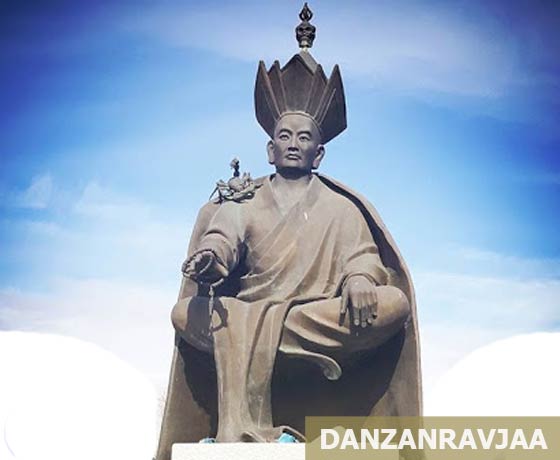
Who was Dulduityn Danzanravjaa?
Dulduityn Danzanravjaa (1803–1856) was a brilliant and unconventional Mongolian lama, poet, playwright, educator, painter, and composer, revered as the Fifth Noyon Khutagt (a high reincarnated lama) of the Gobi Desert. Known for his sharp critiques of feudalism, his progressive views on education and gender equality, and his immense literary and artistic contributions, he remains one of Mongolia’s most extraordinary historical figures.
Early Life and Recognition as a Reincarnated Lama
Danzanravjaa was born into a poor family in what is now Sainshand, Dornogovi Province. He begged alongside his father until the age of five. His spiritual significance was first noticed when he approached a monk and demanded a horse—an unusual request for a child. When asked why, he explained in vivid detail about his past incarnations, leading monks to believe he was the reincarnation of the Gobi Noyon Khutagt.
However, under Qing Dynasty rule, recognizing spiritual reincarnations without imperial approval was forbidden. To protect him, he was concealed under the title “Noyon Tsorj” (a senior monk). Nevertheless, word reached the Qing emperor, who ordered that the boy be examined by the Dalai Lama, the 8th Bogd Gegeen, and the Panchen Lama. If found to be a false claimant, he was to be executed on the spot.
To the astonishment of all, the three great Buddhist leaders unanimously confirmed that Danzanravjaa was indeed the legitimate reincarnation of the Noyon Khutagt.
A Revolutionary Thinker and Cultural Icon
Danzanravjaa studied Buddhism intensely and by the age of 16, he had concluded that the Nyingma school (also known as the “Red Hat” sect) was best suited for the Mongolian people due to its emphasis on mystical experience, poetry, and inclusion of lay practitioners. This put him at odds with more conservative factions of Buddhism.
Despite being a religious figure, Danzanravjaa was deeply critical of Mongolia’s feudal society, elitism, and gender inequality. He believed in universal education, the importance of women’s rights, and the freedom of artistic and intellectual expression.
Education, Theater, and Monasteries
In 1820, at just 17 years old, he founded the Khamar Monastery in Uvur Khamar (near present-day Sainshand), which became not only a spiritual center but also a hub of learning, art, and performance.
He established:
- A public school—rare at the time in Mongolia.
- One of Mongolia’s first professional theaters, which performed plays with philosophical and moral lessons.
- A library containing rare scriptures, manuscripts, and books.
- A museum of natural and spiritual wonders, called “Gobiin Dogshin Chuulgan” (The Fierce Assembly of the Gobi).
By 1840, he had expanded his influence, constructing eight major monasteries across the Gobi region, including:
- Demchog Monastery
- Tsagaan Tolgoi Monastery
- Ereet Monastery
Literary and Artistic Legacy
Danzanravjaa was a prolific writer, leaving behind:
- Over 300 poems
- More than 100 songs
- 10 plays blending satire, philosophy, and social commentary
- Dozens of paintings, some with mystical symbolism
His most famous play, “Saran Khukhuu” (Moon Cuckoo), is still performed today and is considered a cornerstone of Mongolian theater.
Death and Mystery
In 1856, Danzanravjaa died under suspicious circumstances. Many believe he was poisoned, likely due to his growing influence and criticism of the Qing authorities and religious conservatism. Others speculate it may have been suicide or illness, but no definitive evidence has emerged.
Fearing desecration of his remains, his disciple Togtokh secretly preserved his body and sacred relics in hidden chests. These were rediscovered in the 1990s after Mongolia’s democratic revolution.
Legacy Today
- His embalmed remains are now kept at the Danzanravjaa Museum in Sainshand, along with thousands of his original writings, artworks, costumes, and relics.
- The Khamar Monastery has been restored and is a popular destination for spiritual tourism, especially during the “Shambhala Energy Center” festival held near the site.
- Danzanravjaa is increasingly recognized as one of Mongolia’s greatest cultural reformers.
Fun Facts:
- He promoted women’s participation in theater and education—radical for his time.
- Some of his poems explore love, mortality, and human suffering in deeply personal ways.
- He believed that art and humor could teach Buddhist values better than dry lectures.


