
Famous Mongolian Queens


Legendary Queens of Mongolia
Throughout Mongolia’s history, 34 renowned queens have significantly contributed to the nation’s legacy. Often overshadowed by the powerful Khans they supported, these queens played pivotal roles behind the scenes. Here are several exceptional Mongolian queens whose contributions significantly shaped their historical eras.

Queen Oelun (Hö’elün)
Oelun, also known as Hö’elün, belonged to the Olkhonuud lineage of the Hongirad tribe. She was married to Yesugei, a respected Mongol chieftain, and is notably remembered as the mother of Temujin (Genghis Khan). After Yesugei was poisoned by members of the rival Tatar tribe, Oelun faced immense hardships when their own tribe abandoned her and her children. Despite these severe challenges, she successfully raised her sons—Temujin, Khasar, Khachiun, and Temuge—as well as her daughter Temulen, instilling resilience, intelligence, and strategic insight in them. Her dedication and perseverance laid the foundations for Temujin’s rise, culminating in him being proclaimed Genghis Khan in 1206, ultimately uniting Mongolia under his leadership.

Queen Toregene
Toregene, originally from the Naiman tribe, became the wife of Ogedei Khan, the third son of Genghis Khan. She was the mother of five sons—Guyug, Godan, Khulgen, Khuchu, and Kadan. After Ogedei’s death in 1241, Queen Toregene skillfully ruled the Mongol Empire from 1241 to 1246 as regent until her son Guyug Khan took power. Although recognized for her authoritative rule, Toregene’s reign was also marked by significant political maneuvering that led to internal power struggles within the empire.
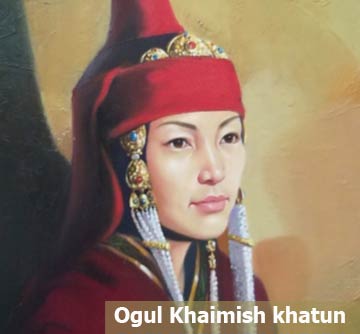
Queen Oghul Qaimish
Oghul Qaimish, daughter of Khutuga Bekh of the Oirat region, was married to Guyug Khan, son of Ogedei Khan. Following Guyug Khan’s death in 1248, Oghul Qaimish assumed leadership from 1248 to 1251, managing state affairs with the consent of powerful princes such as Batu Khan. Her rule, though brief, highlighted the influential role women held in Mongol leadership, supported notably by figures like Queen Sorghaghtani Beki and Qinghai administrators.

Queen Sorghaghtani Beki
Sorghaghtani Beki, daughter of Jaha Khambu and niece of Tooril Khan of the Keraites, married Tolui, Genghis Khan’s youngest son. Renowned for her intelligence, education, diplomatic skills, and religious tolerance, she raised four influential sons—Möngke, Kublai Khan, Hulagu, and Ariq Böke. Her descendants profoundly impacted Mongolian and world history, establishing empires across Asia, including Kublai Khan’s Yuan Dynasty in China and Hulagu’s Ilkhanate in Persia. Highly esteemed by contemporaries and future generations, Sorghaghtani Beki passed away in 1252.

Queen Mandukhai the Wise
Known as “Wise Queen Mandukhai,” Mandukhai was born in 1448 in Tumed province. She married Manduul Khan in 1465, becoming queen at just 17 years old. Following Manduul Khan’s death in 1467, Mandukhai governed Mongolia during a challenging period of political instability. Demonstrating remarkable insight and leadership, she identified and crowned the young Batmunkh, a direct descendant of Genghis Khan, in 1470. Mandukhai’s wisdom and guidance were instrumental in reunifying Mongolia during a period of fragmentation, enabling Batmunkh Dayan Khan to rule for over four decades, restoring stability and unity.
These queens are prime examples of the indispensable roles women played throughout Mongolian history, significantly shaping its political landscape and leaving lasting legacies.


