
Who was Khorloogiin Choibalsan

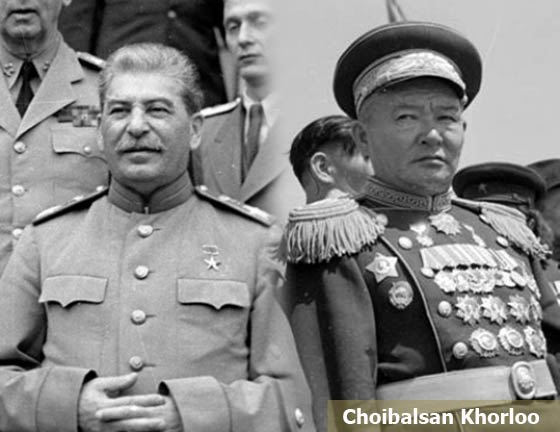
Who Was Khorloogiin Choibalsan?
Often referred to as “the Stalin of Mongolia,” Khorloogiin Choibalsan was born in 1895 in Dornod Province, Mongolia. He served as the leader of the Mongolian People’s Republic and held the rank of Marshal (General Chief Commander) of the Mongolian People’s Army from the 1930s until his death in 1952.
Early Revolutionary Activities
Choibalsan was a member of the Konsulyn Denj (Consular Hill) group, a revolutionary movement formed to resist the Chinese occupation of Outer Mongolia after 1919. He later joined the Mongolian People’s Party (MPP) in 1920 and played a key role in Mongolia’s socialist transformation.
Rise to Power
At the Eighth Party Congress in 1930, Choibalsan implemented aggressive policies, including land confiscation and forced collectivization to accelerate Mongolia’s shift to socialism. In 1936, he and Demid Gelegdorj were appointed Marshals of the Armed Forces. That same year, Choibalsan became head of the newly expanded Ministry of Internal Affairs, giving him control over Mongolia’s internal security apparatus.
The Great Purge in Mongolia
As Minister of Internal Affairs, Choibalsan oversaw one of the darkest chapters in Mongolian history: the political purges of the late 1930s. Under his leadership, an estimated 30,000 to 35,000 Mongolians were executed, including political opponents, Buddhist monks, and members of the aristocracy. These purges were heavily influenced by Joseph Stalin’s policies in the Soviet Union, and Choibalsan closely followed Soviet directives in carrying them out.
In 1939, following the removal of Prime Minister Anandyn Amar, Choibalsan became Mongolia’s uncontested leader, holding the positions of Prime Minister, Minister of War, and Commander-in-Chief of the Mongolian Armed Forces simultaneously.
Role in the Khalkhin Gol Battle (1939)
Choibalsan played a prominent role in the Soviet-Mongolian victory at the Battle of Khalkhin Gol in 1939, where Mongolian and Soviet forces defeated the Imperial Japanese Army. This victory strengthened Mongolia’s strategic alliance with the Soviet Union and solidified Choibalsan’s reputation as a defender of Mongolia’s independence against Japanese expansionism.
Legacy and Controversy
Choibalsan’s legacy in modern Mongolia remains highly debated. While some view him as a staunch protector of Mongolia’s sovereignty and an architect of modernization, others see him as a ruthless dictator responsible for mass executions and human rights violations. His deep loyalty to Stalin and the Soviet Union shaped Mongolia’s political trajectory for decades, leaving a lasting impact on the country’s history.
He remained in power until his death in 1952, marking the end of an era dominated by Soviet influence and authoritarian rule in Mongolia.


