
Mongolian Railway

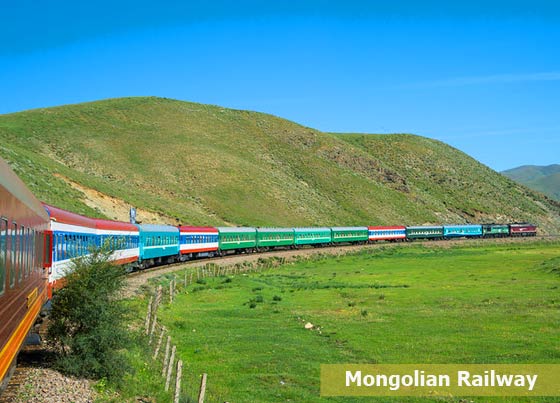
Mongolian Railway: From Coal Transport to International Connectivity
The history of the Mongolian railway dates back to 1938, when the country’s first-ever railway line was established. This initial 43-kilometer stretch connected Ulaanbaatar, the capital, to Nalaikh, a mining town southeast of the city. Built specifically to transport coal from the Nalaikh coal mine to Ulaanbaatar, this humble beginning laid the foundation for a national and international railway system.
Soviet-Mongolian Railway Cooperation
In 1946, Mongolia and the Soviet Union signed a landmark agreement to create a joint-venture railroad system. Under this cooperation:
In 1949, a 400-kilometer railway from Naushki, a Russian border town, to Ulaanbaatar was completed.
In 1955, a further 700-kilometer railway line connecting Ulaanbaatar to Zamiin-Uud, a key border point with China, was completed.
These railways formed the backbone of the Trans-Mongolian Railway, connecting Russia and China through Mongolia. The new railway was of strategic economic and geopolitical significance, acting as a vital corridor for trade and transport between the two major powers.
Development of Railway Workforce
To meet the growing need for qualified engineers, technicians, and staff, Mongolia established educational institutions focused on railway expertise:
In 1951, the Railroad College Industrial Complex was founded.
In 1953, the Railroad Technical School became operational.
Between 1952 and 1957, more than 3,500 specialists graduated from these institutions, supplying much-needed manpower to operate and maintain the expanding railway network.
The official opening ceremony of the Ulaanbaatar–Zamiin-Uud railway was held on December 31, 1955, marking a significant milestone in Mongolian infrastructure development.
Expansion and Modern Role
From its modest start with just a few stations serving a coal route within Ulaanbaatar city limits, the Mongolian railway has grown into a robust transportation network. As of today:
The Trans-Mongolian Railway spans over 1,950 kilometers and includes 78 stations.
The Ulaanbaatar Railway Station is the largest and most significant hub on this route.
Mongolia has a total of approximately 1,200 kilometers of main railway lines, excluding sidings and intersections.
The railway is an integral part of the Trans-Siberian Railway system, connecting Europe and Asia.
Annually, the railway transports around 3.5 million passengers and 18.8 million tons of freight.
Strategic Importance
Today, the Mongolian Railway continues to play a vital role in the country’s economy by supporting domestic trade, facilitating international exports and imports, and promoting regional integration. It serves as a key logistical artery for the movement of coal, copper, iron ore, and consumer goods, as well as a growing number of passengers.


