
Who was Yumjaagiin Tsedenbal?

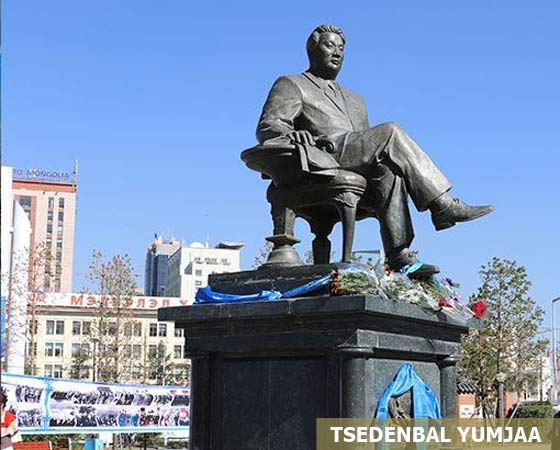
Who Was Yumjaagiin Tsedenbal?
Yumjaagiin Tsedenbal: Mongolia’s Longest-Serving Leader
Early Life and Political Rise: Yumjaagiin Tsedenbal, Mongolia’s first Prime Minister (1952–1974) and longest-serving leader, was born in 1916. His rise in the Mongolian People’s Revolutionary Party (MPRP) began when he was appointed Party Secretary in 1940 at the young age of 24. He quickly consolidated power and became Prime Minister in 1952, remaining in that position until 1974, making him one of the longest-serving leaders in any Eastern Bloc country.
Political Career and Leadership: Tsedenbal remained at the helm of Mongolia’s political landscape for over 44 years, serving as the de facto ruler even when temporarily replaced by Dashiin Damba (1954–1958) as party leader. After securing absolute power, he initiated widespread political purges, eliminating perceived opponents and solidifying his control over the Mongolian government.
Throughout his rule, Tsedenbal closely aligned Mongolia with the Soviet Union, both politically and economically. Under his leadership:
- Mongolia adopted the Cyrillic alphabet in the 1940s, replacing the traditional Mongolian script to strengthen ties with the Soviet Union.
- He prioritized state-controlled economic policies, heavily relying on Soviet assistance for military security and nearly all foreign trade.
- Mongolia remained a Soviet satellite state, following Moscow’s directives in both domestic and foreign policies.
Becoming Head of State (1974–1984): In June 1974, Tsedenbal was elected Chairman of the Presidium of the People’s Great Khural, officially making him Mongolia’s head of state. However, as his rule progressed, he became increasingly reliant on political purges to maintain power, eliminating potential rivals and strengthening Soviet influence in Mongolia.
Exile and Death: In August 1984, while Tsedenbal and his family were in Moscow, he was forcibly removed from power, officially due to poor health. He remained in exile in Moscow until his death in 1991, never returning to Mongolia.
Personal Life: Tsedenbal was married to Anastasia Filatova, a Russian woman who wielded significant influence in Mongolian politics and society. Her presence reinforced Soviet-Mongolian relations, and she was a key figure in Tsedenbal’s administration.
Despite his long rule, Tsedenbal remains a controversial figure—credited with modernizing Mongolia under Soviet guidance but criticized for his authoritarian rule and heavy dependence on the USSR.


