
Green Tara

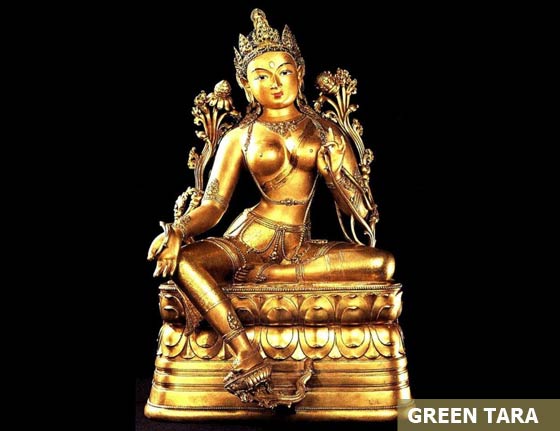
Green Tārā: The Mother of Compassion in Vajrayana Buddhism
Green Tārā is a revered meditation deity in Tibetan Vajrayana Buddhism, widely worshipped for her swift compassion, active protection, and spiritual guidance. She is known as the “Mother of Liberation”, embodying the enlightened activity of compassion (karuṇā), loving-kindness (mettā), and emptiness (śūnyatā).
Green Tārā is particularly cherished for her readiness to come to the aid of those in distress. Just as a loving mother instinctively rushes to help her child, Green Tārā is believed to respond immediately to the prayers of those in need. Practitioners often turn to her in times of fear, illness, or hardship, trusting in her boundless maternal energy.
Spiritual Practice and Symbolism
Green Tārā is a central figure in Vajrayana meditation and mantra practices. Her mantra is:
“Om Tare Tuttare Ture Soha”
This sacred chant is said to encapsulate the essence of all mantras, offering protection from fear, healing of suffering, removal of obstacles, and the accumulation of merit and wisdom.
She represents active compassion—in contrast to White Tārā, who embodies tranquil compassion and longevity. Green Tārā’s color symbolizes youthful energy and vitality, and her posture—right leg extended, left leg drawn in—shows her readiness to leap to the aid of sentient beings.
Her Many Forms
Green Tārā is one of the 21 main Tārā manifestations, each associated with a specific color, form, and function. However, the variety extends even further:
- 10+ Green forms
- 7 White forms
- 5 Yellow forms
- 2 Blue forms
- 1 Red form
- Up to 76 distinct forms listed by Buddhist scholar Benoytosh Ghosh
- 108 names are traditionally recited in liturgical praise
Her iconography is equally diverse:
- She can appear in peaceful or wrathful forms.
- She may have 2, 4, 8, or 12 arms, each holding symbolic implements.
- Some depictions include a thousand arms and heads, emphasizing her universal reach.
- Her posture varies: sitting, standing, half-lotus, full-lotus, or even reclining—each posture reflecting a different aspect of her spiritual function.
As the Indian master Sarvajñamitra wrote:
“She is a universal form, varied like crystal, since she changes according to circumstance.”
Mongolian Legend of Green Tārā
While canonical Tibetan and Indian texts emphasize Tārā’s emergence from the tears of Avalokiteśvara (the bodhisattva of compassion), Mongolian Buddhist tradition adds a unique local legend:
“Green Tārā used to mischievously disturb children. To teach her a lesson, the Buddha gave her a child of her own. After three years, he hid the child in the mystical realm of Shambhala. Desperate and sorrowful, Tārā searched everywhere but could not find her beloved child. Her grief transformed into deep maternal love for all sentient beings, and she became the goddess of universal motherhood.”
In this story, Tārā’s divine compassion is born out of personal loss, making her a powerful symbol of maternal love, protection, and healing.
Why Practitioners Pray to Green Tārā
Devotees turn to Green Tārā for many blessings:
- Protection from fears, danger, and spiritual obstacles
- Healing from illness—both physical and mental
- Success in endeavors and career
- Fertility and blessings for children
- Spiritual awakening and compassion
She is especially beloved by those seeking swift help and guidance in urgent situations—hence her epithet: “She Who Acts Quickly.”
Green Tārā in Daily Practice
To connect with Green Tārā:
- Recite her mantra (daily or during meditation)
- Visualize her image—green in color, peaceful face, one leg ready to step forward
- Offer incense, flowers, or light to her statue or thangka (sacred painting)
- Reflect on compassion—not just as emotion, but as action toward all beings
Where to See Green Tārā in Mongolia
In Mongolia, Green Tārā is venerated in many monasteries, particularly those following the Tibetan Gelug and Nyingma traditions. Her thangka paintings, statues, and prayer banners can be found across:
- Gandan Monastery (Ulaanbaatar)
- Khamar Monastery (Dornogovi)
- Erdene Zuu Monastery (Karakorum)


