
Mongolia during the Socialist regime

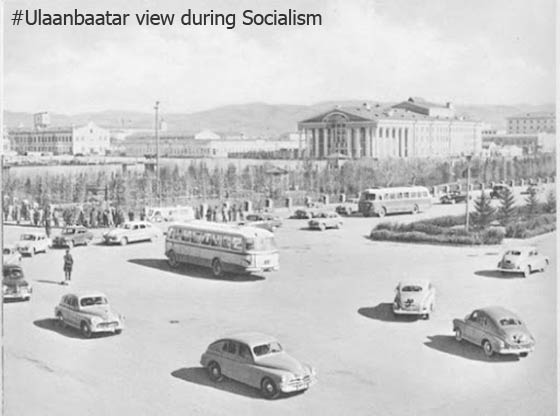
Mongolia during the Socialist regime
Mongolia became one of the first communist countries after the Soviet Union, officially establishing the Mongolian People’s Republic (MPR) in 1924. The country remained under communist rule until 1992, heavily influenced by the Soviet Union both politically and economically.
During this period, Mongolia experienced rapid modernization, industrialization, and social reforms. Major government-led initiatives, such as the Collective Movement, the Atar Campaign (aimed at increasing agricultural production), and literacy programs, significantly transformed the country’s economy, infrastructure, and education system.
Political Repression and Soviet Influence
In 1939, Khorloo Choibalsan became Mongolia’s leader under strong Soviet influence. During his rule, private property was confiscated, religious practices were suppressed, and mass political purges took place. The Great Repression (1937–1939) resulted in the execution of over 30,000 people, including Buddhist monks, intellectuals, and political dissidents.
During World War II, Mongolia supported the Soviet Union by providing resources and aid. In the 1939 Battle of Khalkhin Gol, a joint Soviet-Mongolian force successfully defeated Japanese forces, securing Mongolia’s independence from potential Japanese expansion. After the war, Mongolia attempted to unify with Inner Mongolia, but this was blocked due to geopolitical agreements between the Soviet Union and China.
Economic and Social Progress
After Choibalsan’s death in 1952, Yumjaagiin Tsedenbal took power, ushering in a period of relative stability. Under his leadership:
- In 1961, Mongolia became a member of the United Nations.
- In the 1960s and 1970s, Mongolia’s economy grew with the help of the Soviet Union, which supported the development of industries, railways, and urban infrastructure
- By the 1960s, Mongolia became the first country in Asia to achieve universal literacy.
However, Mongolia also became heavily dependent on the Soviet Union, receiving financial aid and military protection while following strict Soviet policies.
The End of Communism and Transition to Democracy
In the 1980s, as the Soviet Union weakened, democratic movements emerged in Mongolia. In 1984, Tsedenbal was removed from power, and Jambyn Batmönkh became Mongolia’s last communist leader. By 1990, peaceful protests led to the first democratic elections, and in 1992, Mongolia adopted a new democratic constitution, officially ending its communist system.
Why This Is Important for Travelers?
- Historical Landmarks – Travelers can visit sites from Mongolia’s socialist era, including Soviet-style buildings in Ulaanbaatar, the Zaisan Memorial, and former political prisons.
- Cultural Heritage – The effects of Soviet influence remain in architecture, language, and education, though Mongolia has revived its traditional nomadic culture and Buddhism.
- Museum Visits – The National Museum of Mongolia and the Victims of Political Persecution Memorial Museum offer deeper insights into this era.
Mongolia’s history as a socialist state shaped its modern identity while preserving its unique nomadic traditions. Today, it stands as a blend of Soviet-era history and ancient Mongol culture, making it a fascinating destination for history and culture enthusiasts.


